Aurendell. The night the Fading began.
The last petitioner of the day was a shepherd from the eastern hills, and he wanted rain.
He knelt on the marble of the Hall of Open Doors with his hat crushed in both hands, and he did not look up. Nobody looked up in that hall. It was not fear that kept their eyes down. It was the same instinct that keeps a man from staring straight into a hearth he loves. The shepherd said that his wells were low, that his lambs were thin, that his wife had told him it was foolish to trouble the King of the gods over weather. He said it all in one breath, as if he had practiced it on the long road and was afraid it would come apart in his mouth.
"It is not foolish," said Ilmarion. "Go home. It will rain before you reach your gate."
The shepherd wept, which was what they always did, and was led out by the doorwardens, and Ilmarion sat a while in the long light of the evening with his hands open on the arms of his seat. Six thousand years he had sat there. He had answered ten million prayers and forgotten none of them. The rain for the shepherd cost him nothing. It went out of him as breath goes out, without effort, without thought, and somewhere far to the east the clouds turned over like sleepers and began to gather.
That was what he would remember afterward. That it had cost nothing. That it had been the last time.
The hall emptied. The doors, which were never closed, stood open on the terraces and the sea beyond them, and the lamps the Lampwrights had set along the walls came up one by one against the dusk. Ilmarion rose, slowly, the way a man rises who has been sitting all day and not the way a god rises, and he crossed the hall to the balcony and looked down at the world.
He loved it. There was no other honest way to say it. From that height he could see the white terraces of Aurendell stepping down toward the harbor, and the harbor lights, and past them the dark water of the Morvaen Sea with the shapes of the far islands lying on it like sleeping animals. He could feel them all. That was the gift and the burden of what he held. A fisherman's net caught on a reef. A child with a fever in a room above a tannery. A bell being rung in some temple at the edge of the map. He did not watch these things. He simply knew them, the way you know the weight of your own body, and he had known them for so long that he had forgotten it was possible to know anything less.
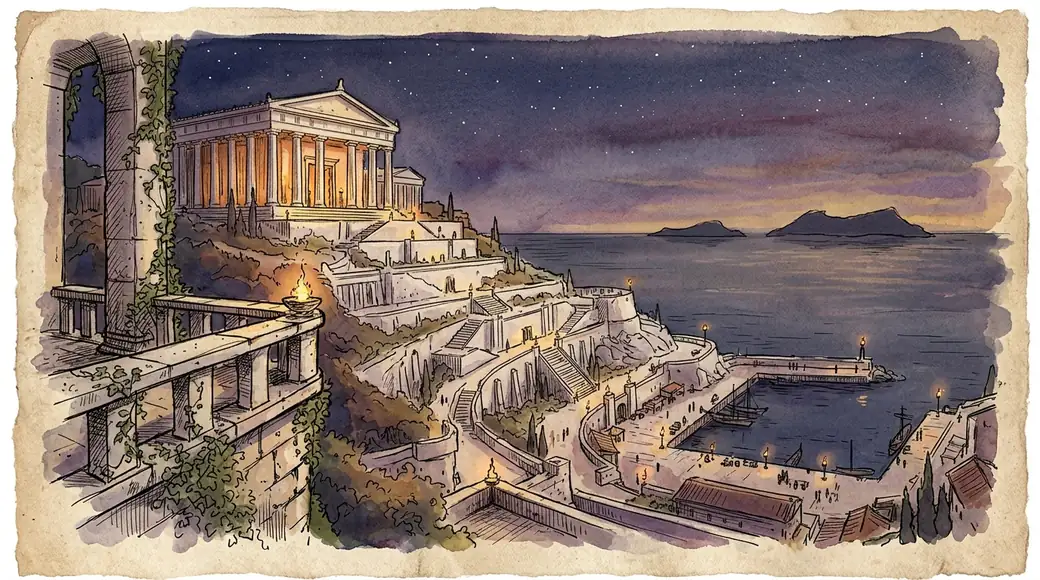
He lifted a hand above the balustrade, for no reason except that the evening was lovely and he wished to touch it. He meant only to warm the air a little. A small thing. A courtesy.
The power did not answer.
That is not quite true. It answered. But it answered late, by the smallest margin a mind could measure, a heartbeat stretched thin, and in that thin place something else was present. It was not a sound. It was the lack of one. The fountain in the courtyard below was still running, he could see the water leaping, and he could not hear it. The sea was breaking against the rocks of the harbor in long white lines, and it made no noise at all.
Ilmarion stood very still.
The silence did not feel like an emptiness. He had known emptiness, in the Age of Chaos, before the lending, when the world had no law in it and a man could step off a cliff that had been a meadow a moment before. This was not that. This had a shape. It leaned. It was like standing in a dark room and understanding, without a single reason, that the room was not empty, that something patient had come in while his back was turned and was now standing at his shoulder, listening to him breathe.
"Who is there?" he said.
His voice did not carry. He felt it leave his mouth and die in the air a hand's breadth away, as if the world had closed its ears.
Then, all at once, sound came back. The fountain spoke. The sea spoke. Somewhere below him a doorwarden laughed at something, and a dog barked, and it was so ordinary and so dear that for a moment he could not bear it. He put his hand flat against the cold stone of the balustrade and held on.
"You are well?"
He turned. Sylvaine stood in the doorway of the balcony with a basket on her arm. She had come straight from the orchards of Elowmere, he could tell, because there was still dew in her hair and a leaf caught in the fold of her sleeve. She was the youngest of the four who might one day inherit, and the only one who had never once asked him when that day would be. She loved him. It was in her face the way the weather is in the sky. He had never doubted it, and he had never deserved it less than he did now.
"I am old," said Ilmarion, and smiled at her.
"Gods do not grow old."
"Then I am the first, and you will all have to forgive me."
She did not laugh. She set the basket down on the balustrade and took a pear from it, a green one, the skin beaded with cold, and put it into his hand as if she were feeding a bird. "You were standing like that when I came in," she said. "You were standing like a man listening for something."
"I was admiring the evening."
"Ilmarion."
The name, in her mouth, was a question and an offer both. He understood that if he said one true sentence now, she would take the whole weight of the rest from him and ask nothing in return. That was what she was. That was what made her dangerous to him. He looked down at the pear in his hand, and he thought of the stone in the far waste, and the iron that had been poured into its grooves, and the words that had been cut there by hands that were not hands of gods.
"I am tired, dear heart," he said. "That is all. Eat with me."
She ate with him. They sat on the terrace steps with the basket between them and watched the stars come out over the water, and she told him about the harvest in the valleys, and about a village that had named its first child of the season after him, and he laughed in the right places. He thought that he did it well. It was only much later that he understood she had known, and had let him lie, because she loved him, and because she believed that a god who would not say a thing had his reasons.
When she had gone he stayed where he was. The lamps burned down along the hall behind him. The night deepened, and the wind came up from the harbor smelling of salt and tar and cut grass, and somewhere very far away, past the edge of his sense, a thing happened that he could not have named and never would have noticed in any other year.
A child was born.
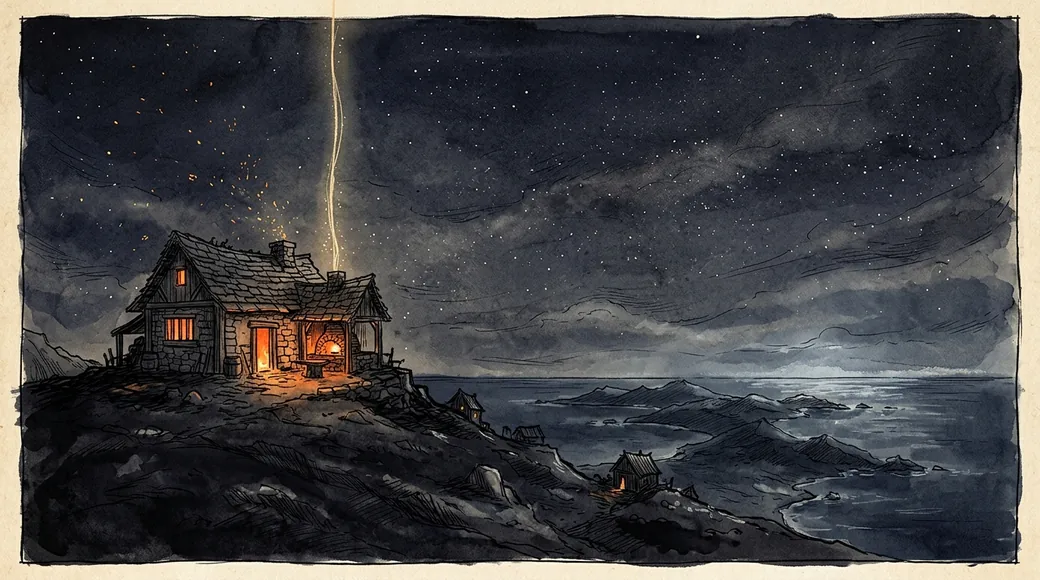
There were a thousand children born in the world every hour, and he had felt every one of them for six thousand years as a small bright coin dropped into a well. This one was no different from the others, except that it came in a house that smelled of hot iron, on a hill black with soot at the edge of the southeast islands, and that the first cry of it reached him clear through the listening dark. The silence had not taken it. It was the only sound in all the world that the silence had not taken.
Ilmarion closed his eyes.
He could have called the other gods then. Caelthar would have come first, because Caelthar always came first, stern and upright and already frightened, with his laws folded under his arm like a sword. Morvaen would have come out of the sea with storm still on his shoulders, and looked at him with that patient bitterness, and asked him why the sea had not been told. Oriel would have come last, quietly, bringing his lamp, and said nothing, because Oriel had always known more than he said. They would have sat with him. They would have taken his hands. And then, sooner than any of them intended it, they would have begun to ask who would hold what he held when he could no longer hold it.
And he would have had to tell them. Not that he was dying. That was the small part. He would have had to tell them what it was that was leaving him, and whose it had been to begin with.
He thought about that for a long time. He thought about the loan, and the lenders, and the long forgetting. He thought about how much easier it was to be loved than to be owed, and how very quietly, over six thousand years, the one had become the other. He did not turn his head toward the northeast, where the ruin lay, where the stone waited under the wind. He did not have to. He knew exactly where it was.
"A little while," he said aloud, to no one, to the listening dark. "Only a little while. I will find the way."
The silence came back, then, as gently as a hand laid on a sleeper's brow. The fountain stopped. The sea stopped. The lamps along the hall went on burning without a flicker, and without a sound, and the god of all the world stood on his balcony with a green pear in his hand and did not call for anyone at all.
Far below him, in the dark town by the harbor, a temple bell rang once on the wind and then did not ring again.
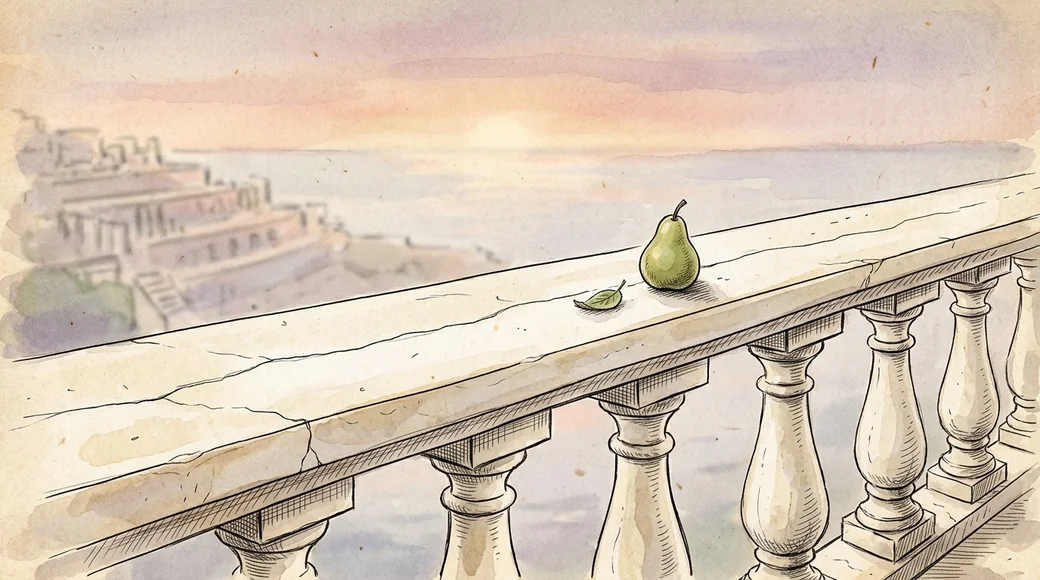
It was not until morning that he noticed the crack. It ran across the face of the balustrade where his hand had rested, fine as a hair, from one end of the stone to the other. It was the first flaw in that marble in six thousand years. He looked at it for a long time, and then, very carefully, as though it might hear, he laid the pear down beside it and went in.
· End of the Prologue ·